Thursday, April 17, 2014
How to Use a Cotter Key
Cotter keys (also known as cotter pins) are small metal fastening devices. The come in a variety of sizes but are all used for the same purpose, safety. Cotter pins are used to insure that a bolt or a pin does not come unscrewed or slide out of its hole. This very simple device can prevent serious damage to equipment and those working with it.
Instructions
Inserting the pin
- 1
Locate the hole in the bolt.
2Push the cotter pin through the hole. Ensure that the pin goes all the way through.
3Bend each side of the pin to wrap it around the bolt with your needle-nose pliers. This will ensure that the cotter pin will not slide out.
Removing the cotter pin
- 4
Use a needle-nose pliers to straighten the sides of the cotter pin.
5Insert one of the ends of the needle-nose pliers into the circular end of the cotter pin.
6Pull the pin straight out with one motion.

Friday, December 6, 2013
How to Use a BernzOmatic OX0225 Gas Torch
The BernzOmatic 0X2550 is a combination cutting, welding and brazing torch. While it is billed as a cutting torch, it is not a torch that one would use for cutting 3/8-inch steel plate. It is very well suited for cutting off small fasteners, but that is about the extent of its cutting capabilities. It is also well suited for welding and brazing.
Instructions
- 1
Screw the oxygen cylinder onto the torchs oxygen valve. The oxygen valve is the taller of the two brass connections, and it has a black plastic knob on the top. Screw the MAPP gas cylinder onto the shorter brass connector with the black plastic knob on the side. Set the bottles on the wire stand included with the kit.
2Purge the lines. Open the oxygen valve until pure oxygen comes out of the end of the burner wand. Close the oxygen valve. Open the gas valve until you detect the odor of the MAPP gas. Close the valve. Purging the lines ensures that there is no oxygen in the gas line, and no gas in the oxygen line.
3Open the MAPP gas valve by turning the black plastic knob on the side of the brass cylinder connection counterclockwise one-eighth turn.
4Ignite the gas at the end of the burner wand by holding the cup of the spark lighter over the end of the wand and squeezing the spring-loaded handle of the spark lighter to create a spark that ignites the gas. Open the gas valve until the flame stops smoking. Open the valve on the oxygen tank connector until the flame loses its feather around the inner core of the flame.
5Perform the intended task. Close the oxygen valve. Close the MAPP gas valve. Unscrew both the oxygen and MAPP gas cylinder.
Thursday, October 17, 2013
Can You Re Use The Brake Pads From A Bad Rotor
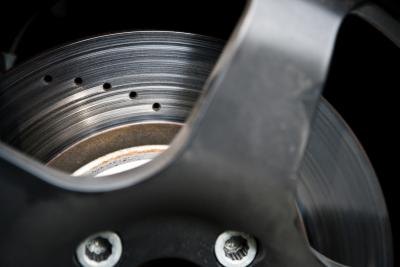
For most people, a "bad" brake rotor is one with a few scratches and grooves in the surface that cut into the pad, or one thats wavy and warped. But theres a lot more going on with your brake rotors than you might see on the surface -- and even thats bad enough as it is.
What is a "Bad" Rotor?
A lot of things can go wrong with a brake rotor. Most obvious are mechanical faults like grooves in the rotor caused by harder particulates in the pad material, cracks in the rotor and waviness or warping in the rotor surface. A front brake rotor must regularly absorb about 30 to 35 percent of all of the energy that goes into moving your car, which creates a lot of heat. Heat, among other things, causes the rotors metal to expand; when the metal cools and contracts, certain zones in the metal will cool faster than others. The uneven cooling pull those zones in different directions, causing the rotor surface to warp and become wavy. Extreme heating can also affect the metals crystalline structure, causing even bigger long-term problems.
Grooved Rotors
All brake rotors that arent brand-new exhibit a certain amount of grooving on the rotor surface. When the grooves are microscopically small, the peaks between the grooves will cut into the brake pad material. Simultaneously, the harder particles in the pad will resist this cutting and abrade the sides of those grooves. Eventually, the grooves will get large enough to be visible and cut large, matching grooves in the pad. So, its not a matter of if the grooved rotor will cut into your pad -- and vice versa -- but rather how far and how much the pads will deepen those grooves. If the rotors dont exhibit grooves deep or sharp enough to catch a fingernail, then you can replace the pads without machine-work or replacement. You can put new pads on a deeply-grooved rotor, but bear in mind that a) it will take some time for the pads to "bed in" and conform to the grooves in the rotor, b) while bedding in, the pads will rapidly accelerate groove widening and c) grooves create weak points in the rotor, increasing the odds that it will crack or shatter.
Warping
A warped rotor could easily eat your new pads alive, and may damage other, more expensive parts in the brake system. This is particularly true for some cars with antilock braking systems. An ABS system works by boosting or dropping brake pressure to each wheel. If the crests of the waves in your rotor are further apart than the pad is long, then the entire pad will drop in between the waves. When the crests come along, theyll shove backward on the pad, creating tiny fluid pressure fluctuations in the brake lines. These oscillations can damage the antilock brake pressure modulator, which costs far more to replace than itll cost you to have the rotors machined flat. So, if your rotors are warped, new rotors are advisable, particularly since new rotors arent usually much more expensive than machining. And, after machining, youll wind up with thinner rotors that are more prone to overheating and structural failure.
Material Changes
This little-known, but endemic, problem has both plagued and bewildered brake mechanics for a century or more. Long ago, mechanics noticed that, after the rotors for warpage or overheating, cars would often roll back into the shop when the rotors re-warped a few months later. And the re-warping problem has existed as alternately a puzzle or a myth -- depending upon who you asked -- since then. But, fairly recently, engineers have discovered that, following an episode of extreme overheating, the areas of the rotor that got the hottest would change in crystalline structure from the normal ferrite structure to the far harder cementite. Cementite, also known as iron carbide, is much like a ceramic and has far different properties in terms of hardness, abrasiveness and thermal conductivity. Think of chunks of oak floating in frozen ice cream, and youve got the right idea. Once these cementite spots form and penetrate the rotor surface to more than a few nanometers, the rotor is shot and will quickly self-destruct.
Sunday, October 13, 2013
How to Use a Torque Stick

Over tightening a bolt or a lug nut can cause a real problem. The bolt can get jammed or stripped and you may have to weld it off or install special inserts to make its hole useable again. To avoid this hassle and the potential cost of professional repairs, use a torque wrench, which is also known as a torque stick because of its long, straight shape. The price of these tools varies based on their length and power.
Instructions
- 1
Consult the manual that came with your vehicle to determine how much torque adjustment is required for a certain task and purchase a torque stick accordingly. Choose a metric or standard wrench based on the requirements of your application.
2Locate the dial and indicator needle on the torque stick. Adjust the dial to the torque rating required by your application so that you are sure not to over tighten your bolt.
3Tighten the bolt slowly until you here a cracking sound and feel a slight break in pressure. This indicates that your bolt is set to the correct amount of torque.
4Double-check that you have set the right amount of torque by applying one more slow pull on the wrench. It should crack right away to indicate that the level is correct. Re-adjust the dial and repeat the process if this does not occur. Note that some torque wrenches are designed to lock at this point and some will continue tightening with pressure. Do not tighten bolts beyond their ratings.